

How Long Can You Not Wear Makeup After Lasik
What to await earlier, during, and after surgery will vary from doctor to doc and patient to patient. This department is a compilation of patient information developed by manufacturers and healthcare professionals, merely cannot replace the dialogue you should have with your doctor. Read this information carefully and with the checklist, discuss your expectations with your doctor.
- Before Surgery
- During Surgery
- Later Surgery
Before Surgery
If you decide to go ahead with LASIK surgery, you will need an initial or baseline evaluation by your heart doctor to determine if yous are a skilful candidate. This is what yous need to know to gear up for the exam and what you should expect:
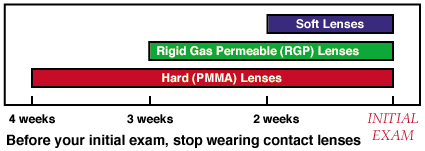
If you lot wear contact lenses, it is a skilful thought to stop wearing them before your baseline evaluation and switch to wearing your glasses total-time. Contact lenses modify the shape of your cornea for upwards to several weeks after you have stopped using them depending on the type of contact lenses you vesture. Non leaving your contact lenses out long enough for your cornea to assume its natural shape before surgery can have negative consequences. These consequences include inaccurate measurements and a poor surgical plan, resulting in poor vision afterward surgery. These measurements, which determine how much corneal tissue to remove, may need to be repeated at least a calendar week later on your initial evaluation and before surgery to make sure they have non inverse, especially if you wear RGP or hard lenses. If you wear:
- soft contact lenses, you lot should stop wearing them for 2 weeks before your initial evaluation.
- toric soft lenses or rigid gas permeable (RGP) lenses, you should stop wearing them for at least three weeks before your initial evaluation.
- hard lenses, you should end wearing them for at least 4 weeks before your initial evaluation.
Y'all should tell your doctor:
- almost your past and present medical and eye weather
- well-nigh all the medications you are taking, including over-the-counter medications and any medications y'all may be allergic to
Your doctor should perform a thorough eye exam and discuss:
- whether you are a adept candidate
- what the risks, benefits, and alternatives of the surgery are
- what y'all should expect before, during, and afterwards surgery
- what your responsibilities will be before, during, and afterwards surgery
You should have the opportunity to enquire your dr. questions during this discussion. Give yourself plenty of fourth dimension to think about the risk/benefit discussion, to review whatever informational literature provided by your doctor, and to accept any additional questions answered by your doctor before deciding to go through with surgery and before signing the informed consent form.
Y'all should not feel pressured by your doctor, family, friends, or anyone else to make a decision about having surgery. Carefully consider the pros and cons.
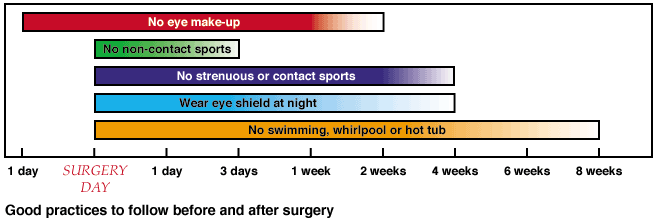
The day before surgery, you should stop using:
- creams
- lotions
- makeup
- perfumes
These products as well as droppings along the eyelashes may increase the adventure of infection during and after surgery. Your doctor may ask you to scrub your eyelashes for a period of time before surgery to get rid of residues and debris forth the lashes.
Besides before surgery, conform for transportation to and from your surgery and your kickoff follow-up visit. On the 24-hour interval of surgery, your md may give you some medicine to make y'all relax. Because this medicine impairs your ability to drive and because your vision may be blurry, even if you don't drive brand sure someone can bring y'all domicile afterward surgery.

During Surgery
The surgery should have less than xxx minutes. You volition lie on your back in a reclining chair in an test room containing the light amplification by stimulated emission of radiation organisation. The laser system includes a large machine with a microscope attached to information technology and a computer screen.
A numbing drop volition exist placed in your eye, the area around your centre volition be cleaned, and an instrument called a lid speculum volition exist used to concur your eyelids open.
Your medico may use a mechanical microkeratome (a blade device) to cutting a flap in the cornea.
If a mechanical microkeratome is used, a ring will be placed on your eye and very high pressures will be applied to create suction to the cornea. Your vision will dim while the suction ring is on and you lot may feel the pressure and experience some discomfort during this role of the procedure. The microkeratome, a cutting instrument, is fastened to the suction band. Your md volition utilize the blade of the microkeratome to cut a flap in your cornea. Microkeratome blades are meant to be used just in one case and then thrown out. The microkeratome and the suction ring are then removed.
Your doctor may utilise a light amplification by stimulated emission of radiation keratome (a laser device), instead of a mechanical microkeratome, to cutting a flap on the cornea.
If a light amplification by stimulated emission of radiation keratome is used, the cornea is flattened with a clear plastic plate. Your vision will dim and you lot may experience the force per unit area and experience some discomfort during this part of the procedure. Laser energy is focused inside the cornea tissue, creating thousands of minor bubbles of gas and water that aggrandize and connect to separate the tissue underneath the cornea surface, creating a flap. The plate is and then removed.
Y'all volition be able to come across, but you volition experience fluctuating degrees of blurred vision during the rest of the procedure. The doctor will then lift the flap and fold it dorsum on its hinge, and dry the exposed tissue.
The light amplification by stimulated emission of radiation will exist positioned over your middle and yous will be asked to stare at a light. This is not the light amplification by stimulated emission of radiation used to remove tissue from the cornea. This low-cal is to help you lot go on your middle fixed on one spot once the laser comes on. Annotation: If you cannot stare at a fixed object for at least 60 seconds, you may not be a good candidate for this surgery.
When your eye is in the right position, your physician will outset the light amplification by stimulated emission of radiation. At this bespeak in the surgery, you may become aware of new sounds and smells. The pulse of the laser makes a ticking sound. As the laser removes corneal tissue, some people have reported a smell similar to burning hair. A computer controls the amount of laser energy delivered to your eye. Before the showtime of surgery, your dr. volition have programmed the reckoner to vaporize a particular amount of tissue based on the measurements taken at your initial evaluation. After the pulses of laser energy vaporize the corneal tissue, the flap is put back into position.
A shield should be placed over your eye at the end of the procedure as protection, since no stitches are used to hold the flap in place. Information technology is of import for you lot to wear this shield to prevent you from rubbing your eye and putting pressure on your eye while you sleep, and to protect your centre from accidentally being hit or poked until the flap has healed.
Later on Surgery
Immediately after the procedure, your eye may burn, itch, or experience like at that place is something in it. Y'all may experience some discomfort, or in some cases, mild hurting and your md may suggest you have a mild pain reliever. Both your eyes may tear or h2o. Your vision will probably exist hazy or blurry. You volition instinctively want to rub your centre, but don't! Rubbing your middle could dislodge the flap, requiring further handling. In addition, you may experience sensitivity to light, glare, starbursts or haloes around lights, or the whites of your eye may await red or bloodshot. These symptoms should meliorate considerably within the first few days later on surgery. You should plan on taking a few days off from work until these symptoms subside. You should contact your dr. immediately and not wait for your scheduled visit, if y'all experience severe pain, or if your vision or other symptoms get worse instead of ameliorate.
You should meet your physician inside the first 24 to 48 hours afterwards surgery and at regular intervals later on that for at least the first six months. At the first postoperative visit, your doctor will remove the heart shield, test your vision, and examine your middle. Your doctor may give you lot ane or more than types of center drops to accept at home to assistance prevent infection and/or inflammation. You may besides be advised to utilize artificial tears to assist lubricate the eye. Do non resume wearing a contact lens in the operated eye, even if your vision is blurry.
You should wait 1 to three days post-obit surgery before get-go any non-contact sports, depending on the amount of activity required, how you feel, and your doctor's instructions.
To aid prevent infection, you may demand to look for upwardly to two weeks after surgery or until your doctor advises you otherwise before using lotions, creams, or brand-upwards around the eye. Your doc may advise y'all to go along scrubbing your eyelashes for a menses of time later on surgery. You should also avert pond and using hot tubs or whirlpools for i-ii months.
Strenuous contact sports such equally battle, football, karate, etc. should not be attempted for at to the lowest degree four weeks after surgery. It is important to protect your eyes from annihilation that might go far them and from being hit or bumped.
During the first few months later surgery, your vision may fluctuate.
- It may take up to three to six months for your vision to stabilize after surgery.
- Glare, haloes, difficulty driving at night, and other visual symptoms may also persist during this stabilization period. If farther correction or enhancement is necessary, you should await until your heart measurements are consequent for two consecutive visits at least iii months apart before re-operation.
- It is important to realize that although altitude vision may improve afterward re-performance, it is unlikely that other visual symptoms such as glare or haloes will improve.
- It is likewise important to notation that no laser company has presented enough evidence for the FDA to make conclusions about the condom or effectiveness of enhancement surgery.
Contact your heart medico immediately, if y'all develop any new, unusual or worsening symptoms at whatever point subsequently surgery. Such symptoms could betoken a problem that, if non treated early plenty, may lead to a loss of vision.
Source: https://www.fda.gov/medical-devices/lasik/what-should-i-expect-during-and-after-surgery
Posted by: woodsgreaughts.blogspot.com
0 Response to "How Long Can You Not Wear Makeup After Lasik"
Post a Comment