

Queens Of Egypt Did They Wear Makeup?
How ancient Egypt shaped our idea of dazzler
(Epitome credit:
Ii Temple Place/Macclesfield Museum
)
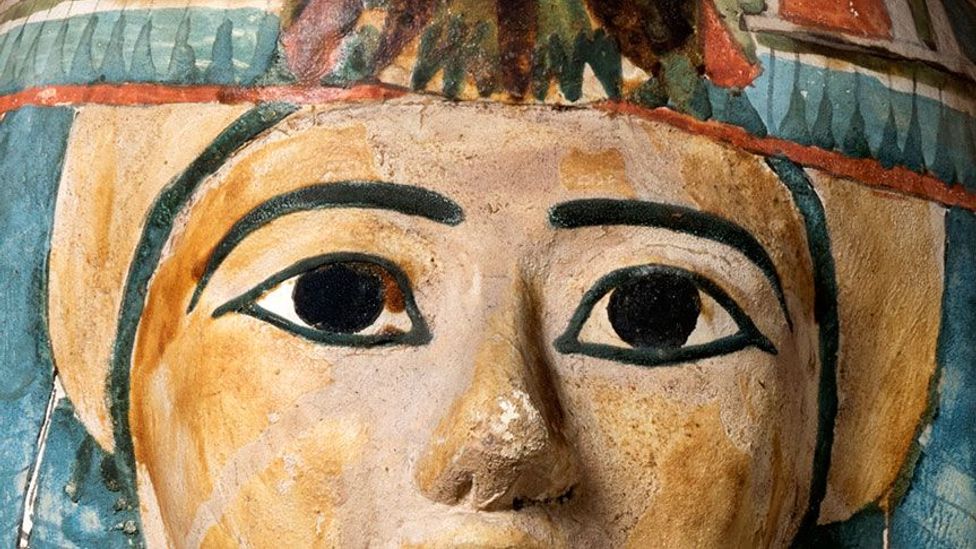
Pop civilisation is steeped in images of smoky-eyed pharaohs and their queens. Were the ancient Egyptians insufferably vain – or are we just projecting our ain values onto them? Alastair Sooke investigates.
W
Walking around Beyond Dazzler, the new exhibition organised past charitable foundation the Bulldog Trust in the neo-Gothic mansion of Two Temple Place in central London, you would be forgiven for thinking that the ancient Egyptians were insufferably vain.
Many of the 350 exhibits, drawn from the overlooked collections of Uk'south regional museums, consist of what we would call dazzler products, of ane sort or another.
In that location are dinky combs and handheld mirrors made of copper alloy or, more rarely, silver. In that location are siltstone palettes, carved to resemble animals, which were used for grinding minerals such as green malachite and kohl for eye makeup.
There are also pale calcite jars and vessels of assorted sizes, in which makeup, too every bit unguents and perfumes, could be stored. Then there is a scrap of human pilus that suggests the ancient Egyptians normally wore hair extensions and wigs.
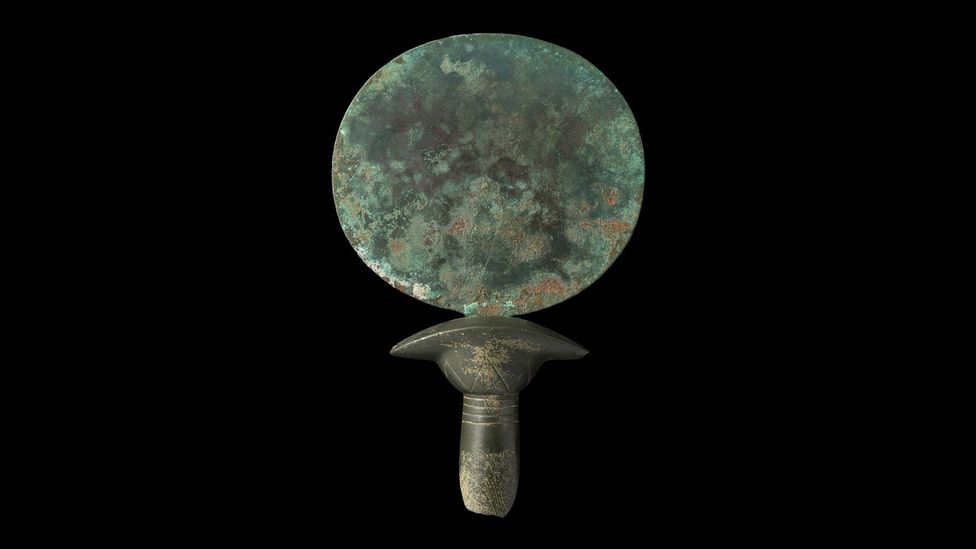
This copper alloy mirror from the 2nd Millennium BC has a handle made out of stone that looks like a cavalcade of papyrus (Credit: Courtesy Two Temple Place/Macclesfield Museum)
And, of form, in that location are lots of hit examples of Egyptian jewellery, including a cord of chaplet, decorated with carnelian pendants in the shape of poppy heads, found in the grave of a small child wrapped in matting.
In short, ancient Egyptians of both sexes manifestly went to nifty lengths to touch up their advent.
Moreover, this was but as true in decease as it was in life: witness the smoothen, serene faces, with regular features and prominent eyes emphasised by dramatic black outlines, typically painted onto cartonnage mummy masks and wooden coffins.
Withal, for modern archaeologists, the ubiquity of dazzler products in ancient Arab republic of egypt offers a conundrum.
On the one hand, information technology is possible that ancient Egyptians were besotted with superficial appearance, much as nosotros are today. Indeed, peradventure they even gear up the template for how we however perceive beauty.
But, on the other, in that location is a run a risk that we could project our own narcissistic values onto a fundamentally dissimilar civilisation. Is it possible that the significance of cosmetic artefacts in ancient Egypt went across the frivolous want simply to look attractive?
Sensibly sexy
This is what many archaeologists now believe. Accept the mutual employ of kohl eye makeup in ancient Egypt – the inspiration for smoky eye makeup today. Recent scientific inquiry suggests that the toxic, lead-based mineral that formed its base would have had anti-bacterial properties when mixed with wet from the eyes.
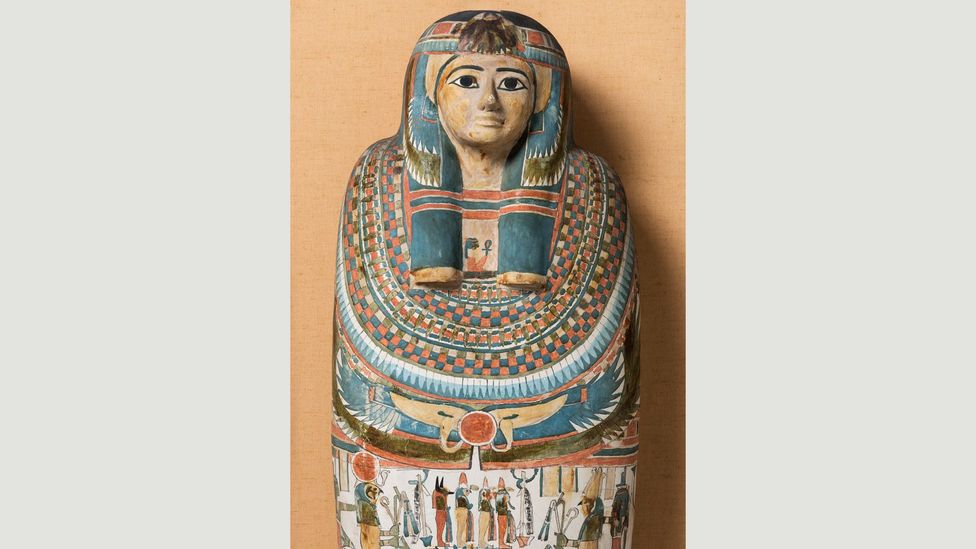
Elaborate sarcophagi draw faces with heavy eye-liner – but brand-up for the ancient Egyptians was functional as well every bit aesthetic (Credit: Two Temple Place/Macclesfield Museum)
In addition, the heavy application of kohl around the eyes would take helped to reduce glare from the sun. In other words, at that place were simple, practical reasons why both men and women in ancient Egypt wished to wear eye makeup.
It's the same with other aboriginal Egyptian 'dazzler products'. Wigs helped to reduce the run a risk of lice. Jewellery had powerful symbolic and religious significance.
A fired clay female figure, depicting an erotic dancer, excavated at Abydos in Upper Egypt and now in the exhibition at Two Temple Place, is embellished with indentations that were meant to correspond tattoos. Of form, in ancient Egypt, tattoos probably had a decorative purpose.
But they may take had a protective function besides. There is evidence that, during the New Kingdom, dancing girls and prostitutes used to tattoo their thighs with images of the dwarf deity Bes, who warded off evil, as a precaution confronting venereal disease.
"The more than I attempt to sympathise what the Egyptians themselves understood as 'beautiful'", says Egyptologist Joyce Tyldesley, "the more disruptive information technology becomes, because everything seems to have a double purpose. When information technology comes to ancient Egypt, I don't know if 'beauty' is the right word to use."
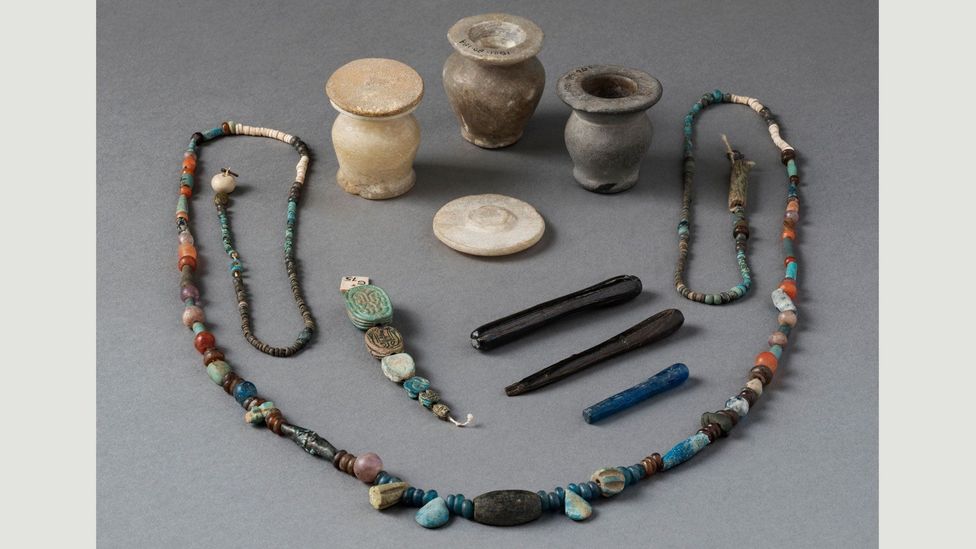
These cosmetic pots contained kohl, which the ancient Egyptians applied similar eye-liner, peradventure to screen out the dominicus (Credit: Ii Temple Identify/Ipswich Museum)
To complicate matters farther, there are center-catching exceptions to the general rule whereby elite ancient Egyptians presented themselves in a stereotypically 'beautiful' manner.
Consider the official portraiture of the Middle Kingdom pharaoh Senwosret Iii. Although his naked trunk is athletic and youthful – idealised, in line with earlier royal portraits – his face up is careworn and cracked with furrows. Moreover his ears, to modern viewers, appear comically large – inappreciably an aspect, you lot would remember, of male beauty.
Even so, in aboriginal Egypt, the event wouldn't have been funny. "In the Old Kingdom, kings were god-kings," explains Tyldesley, who is a senior lecturer at the Academy of Manchester. "But by the Heart Kingdom, kings [such as Senwosret] recognised that things could crumble and go incorrect, which is why they look a bit worried."
"The large ears are telling us that this male monarch will mind to the people," she adds. "It would exist incorrect to take his portrait literally and say he looked like this."
Queen of the Nile
Why, then, do we proceed to associate aboriginal Egypt with glamour and dazzler? "We notwithstanding find ancient Egyptian civilisation very seductive," agrees Tyldesley, who believes that this is due to the afterlives of two famous Egyptian queens: Cleopatra and Nefertiti.
E'er since artifact, following the Roman conquest of Arab republic of egypt, Cleopatra has been known equally a paragon of dazzler. Meanwhile the discovery, in 1912, of the famous painted bust of Nefertiti, at present in Berlin's Egyptian Museum, turned a little-known wife of the pharaoh Akhenaten into a pin-up of the ancient globe.
Yet, says Tyldesley, who has written a biography of Cleopatra and is researching a book on Nefertiti, in that location is irony to the fact that these two Egyptian queens now resonate every bit sex symbols.
For 1 thing, explains Tyldesley, "Cleopatra has given u.s. the idea that ancient Egyptian women were all beautiful, merely we don't really know what she looked like."
In her coinage, Tyldesley says, "Cleopatra had a large olfactory organ, a protruding chin, and wrinkles – non what well-nigh people would phone call beautiful. You could contend that she appeared on her coins like that on purpose, because she wanted to look stern, and not particularly feminine. Merely even Plutarch, who never met her either, said that her dazzler was in her vivacity and her voice, and not in her appearance. Withal we accept decided that she was beautiful and that she has to look similar Elizabeth Taylor. I recollect that the idea of Cleopatra, rather than Cleopatra herself, has influenced u.s.."
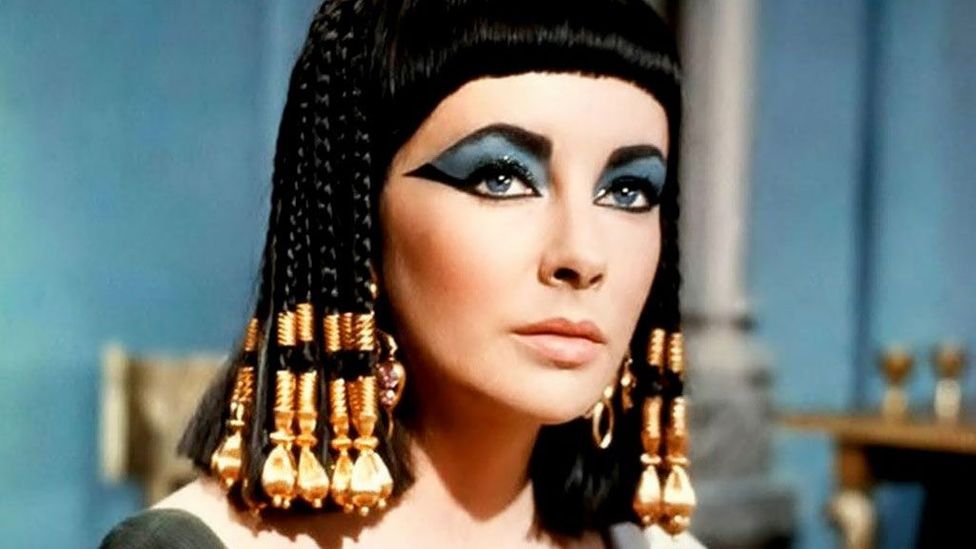
The notion of aboriginal Egyptians as glamorous comes largely from Cleopatra, whose wiles ensnared Caesar – Elizabeth Taylor did not discredit that idea (Credit: 20th Century Trick)
As for Nefertiti, Tyldesley points out that her bust is not typical of aboriginal Egyptian art: "Information technology'due south an unusual statue in that information technology'due south got all the plaster on and it's colourful – a lot of the artwork we have is more stereotyped and less personal-looking than that."
Moreover, the moment when the bust was unveiled in Berlin – in 1923 – was crucial to its reception. 'Egyptomania' was in the air, following the discovery of the tomb of Tutankhamun the previous twelvemonth, and Nefertiti's angular, geometric advent chimed with fashionable gustatory modality. "She's very modern-looking, very Art Deco," says Tyldesley. "So everybody seemed to like her. It's hard to find everyone who didn't think that Nefertiti was beautiful."
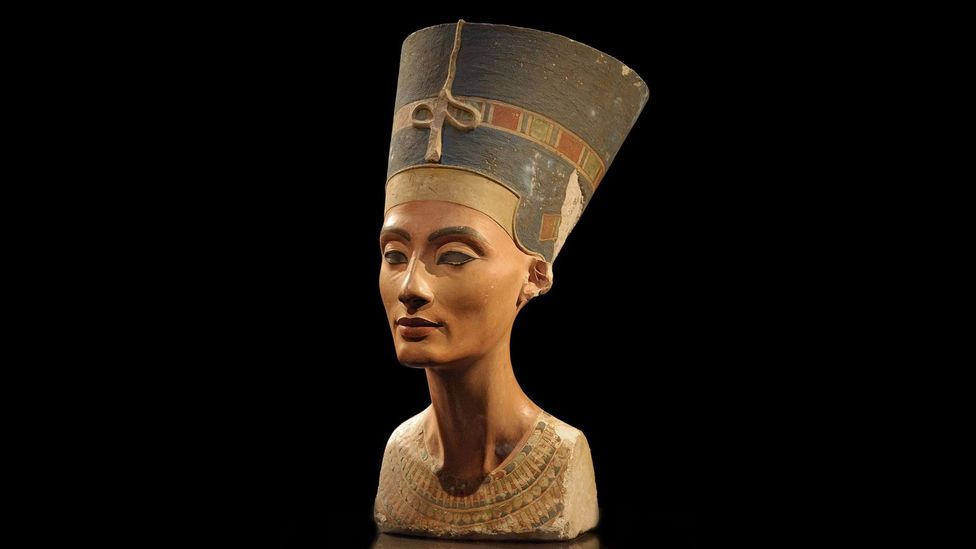
When this bust of Nefertiti was discovered in 1912, the queen instantly became a sexual practice symbol of the ancient earth (Credit: Philip Pikart/Wikipedia/CC BY-SA 3.0)
During the '20s, the bust of Nefertiti too benefited from the power of the mass media to turn her into a star. "A hundred years before, without newspapers or the movie theater, that wouldn't have happened," says Tyldesley. "She would accept gone into a museum and nobody would have fabricated the fuss they did."
She pauses. "I wonder whether the fact that Nefertiti was put on display in Berlin as a major find actually influenced what we saw. After all, beauty, as nosotros know, is in the eye of the beholder."
Alastair Sooke is Art Critic of The Daily Telegraph
If y'all would like to comment on this story or anything else you have seen on BBC Culture, head over to our Facebook folio or message us on Twitter
Source: https://www.bbc.com/culture/article/20160204-how-ancient-egypt-shaped-our-idea-of-beauty
Posted by: woodsgreaughts.blogspot.com
0 Response to "Queens Of Egypt Did They Wear Makeup?"
Post a Comment