

How To Draw Realistically From A Picture
Illustrations can enhance the way and appeal of your ecommerce site. However, creating illustrations (or hiring skilled illustrators) can be plush and time-consuming.
Thankfully, you can learn how to turn a moving-picture show into a line drawing in Photoshop CC 2022 following the steps below. Images of objects isolated on a white background piece of work best for this technique, making this a dandy pick for modifying or enhancing product photos.
Receive free ecommerce & product photography tips
Before you begin: How to outline an image in Photoshop
If you want to plough a photo into a pencil sketch in Photoshop, but y'all don't want it to look like you did it in Photoshop, y'all'll need to pay attention to detail and set up your image properly before yous apply any filters.
In the following tutorial, we'll go over one method that shows you how to convert your image into a pencil sketch flawlessly, and then we'll discuss specific tools y'all can explore to achieve other image outlining effects in Photoshop.
Not all photos are the same, and then you'll need to utilize your judgement as yous suit filters, blurs and layer opacities each time you apply Photoshop to convert a photo into a line drawing using the steps below.
How to turn a picture into a line drawing in Photoshop
- Accommodate the contrast of your photo
- Set up your layers
- Convert the paradigm to grayscale using an adjustment layer
- Convert your photo to a line drawing
- Set up your Background and Foreground colors
- Add Pencil Shading to your image
- Add a cantankerous-hatching issue to your prototype
- Make your final tweaks
Step 1: Suit the dissimilarity of your photo

In the example photograph, the image of the shoes and sunglasses contrast significantly against the white groundwork. The image of the change purse and perfume tube, all the same, are so light they almost blend into the background.
We'll adjust the dissimilarity of the entire photo so the pocketbook and tube stand out more than.
Become to your Layers panel and make sure the layer that contains your image is selected. If you're working in a flattened image (such as a JPG), this layer volition be the locked Background layer.

Cull Epitome > Adjustments > Curves from the dropdown menu at the meridian of Photoshop'southward application window.

The Curves dialog box will appear. Brand sure Preview is checked.
In the graph on the left side of the dialog box, click on the middle of the line running diagonally through the graph and elevate downward, creating a curved line in the graph. You'll notice that the dark areas of the image will become darker, while the lighter areas will remain light.
Note: If yous're working in a CMYK image, you'd pull up on the centre of the line instead of down.

Once yous're satisfied with the increased contrast of the image, click OK.
Step ii: Set upwards your layers
In your Layers panel, duplicate the layer containing your image three times, so that you have four identical layers.
To duplicate a layer, select the layer in the Layers panel, click on the Layers panel menu in the upper correct manus corner of the panel, and choose Duplicate Layer.

Stride 3: Convert the image to grayscale using an adjustment layer
Select the duplicated layer at the top of the Layers console.

Select the Adjustment Layer icon at the lesser of the Layers console (the icon looks like a half black, one-half white circumvolve). Choose Hue/Saturation from the dropdown menu.

You've just created an adjustment layer for Hue/Saturation, which means all layers that appear beneath the adjustment layer volition retain the Hue/Saturation properties you prepare for that adjustment layer.
With your adjustment layer still selected, get to your Properties panel, located to the correct of your paradigm past default. If you don't encounter your Properties panel, y'all can cull Window > Properties from the dropdown menu at the top of the Photoshop application window.
You'll see three sliders in the Properties panel: Hue, Saturation and Lightness. Drag the slider for Saturation every bit far as it will become to the left, so that the value listed for Saturation is now -100.

Your image now appears grayscale.
How to convert an prototype to grayscale: an additional method
Having the Hue/Saturation adjustment layer makes your image appear grayscale, but if yous want to eliminate all colour completely from your paradigm as you work, you can convert your image to grayscale by choosing Image > Way > Grayscale from the dropdown menu at the top of the application window.
If you have an adjustment layer in place when y'all convert to grayscale, the adjustment layer will be deleted.
Step 4: Convert your photo to a line cartoon
In this step, you lot'll learn how to outline, or trace, the picture in Photoshop using a serial of layer effects. If your goal is to create merely an outline of your photograph, you lot may decide your picture is complete after this stride.
Make your peak two duplicated layers invisible by clicking on the eye icons next to the layers in the Layers panel. Then select the visible layer that is second from the bottom of the Layers console.
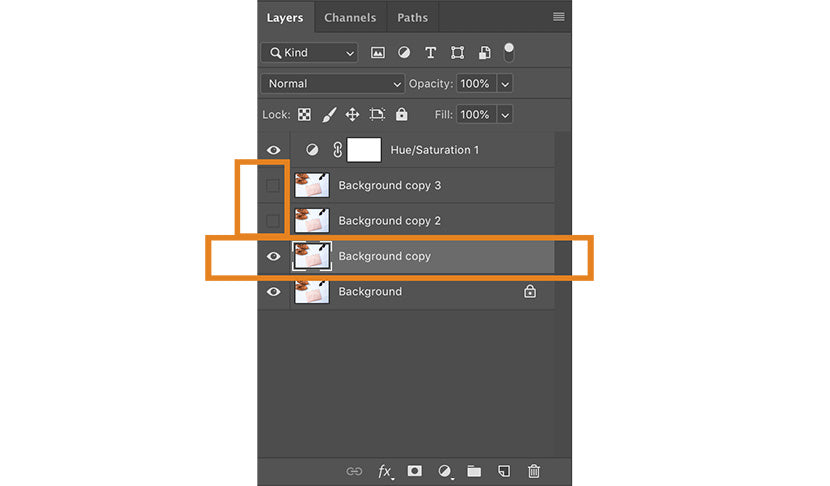
Click on the dropdown menu at the top of the Layers panel side by side to Normal. Select Colour Dodge.

With the same layer still selected, invert the paradigm by typing CTRL+I (COMMAND+I on a Mac). You tin as well capsize the image by choosing Image > Adjustments > Invert from the dropdown menu at the height of Photoshop's application window.
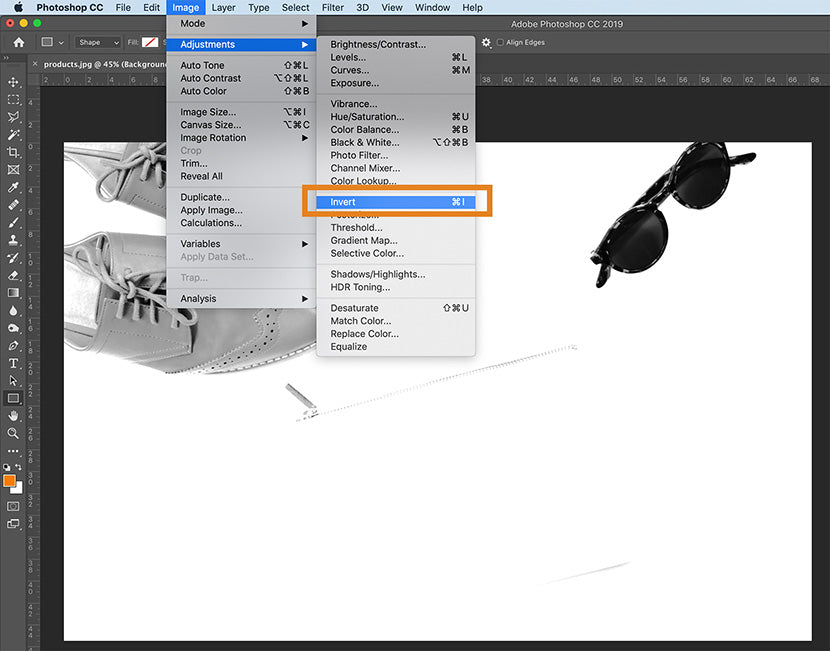
Side by side, choose Filter > Mistiness > Gaussian Blur from the dropdown card at the peak of the awarding window.
In the Gaussian Blur dialog box that appears, suit the slider until your image looks like a line drawing.
Moving the slider the left will result in thinner lines; moving the slider to the correct and increasing the blur will thicken and darken the lines, and add some shading to the image.
Make sure that Preview is checked in the dialog box so that you can come across how the image changes as you move the slider to the right or to the left.

How to make the strokes of your line drawing thicker in Photoshop
If you want to thicken the strokes of your line drawing, duplicate your original layer i more time and move the new layer above the layer you just adjusted (layer with Color Dodge blend way).
Cull Filter > Filter Gallery... from the dropdown menu at the top of the application window.
Choose Glowing Edges under Stylize. Here, yous can adjust the Edge Width on the right-hand side of the window. Reducing Edge Brightness will result in a cleaner edge.
Click OK.

Dorsum in your layer, click CTRL+I (COMMAND+I on a Mac) to invert the layer, and modify the layer blend fashion to Multiply.
The outlines of your image will at present be thicker and darker.
Step 5: Set your Background and Foreground Colors
In your Toolbar, set up your Background Color to white by double-clicking on the Background Color icon. In the Color Picker (Background Color) dialog box, click on the upper left-mitt corner of the large color box.
Next set your Foreground Colour to a medium gray. Double click on the Foreground Colour square in the Toolbar. In the Color Picker (Foreground Color) dialog box, click midway down the left side of the large colour box.
Other colors in the big color box (such as the blues and reds visible in the Color Picker panel image below) are irrelevant since you're keeping the cursor all the style to the left side of the large color box.

Related: 9 alternatives to white groundwork product photography
Step 6: Add Pencil Shading to your image
In the Layers panel, select the layer above the layer you just worked with. Click on the center icon to make the layer visible again. Your image will now look like a black-and-white photograph again.
Choose Filter > Filter Gallery... from the dropdown carte at the top of the application window.

In the Filter window, click on the folder marked Sketch and choose Charcoal.
Adjust the Charcoal Thickness, Item, and Lite/Night Balance sliders until the paradigm in the preview window has the appropriate corporeality of detail. Call up, you already have a line drawing of the photograph in a lower layer, so you only need to create shading in this stride.
Click OK.

In the Layers console, click on the dropdown card next Normal and adjust the Layer Alloy Mode of the charcoal layer to Multiply.

Step vii: Add a cross-hatching effect to your paradigm
In the Layers panel, click the centre icon on the top layer to make the layer visible. All layers should at present be visible in your image.
With the last layer selected, choose Filter > Filter Gallery... once more from the dropdown bill of fare at the summit of the application window. If you see the Filter Gallery option more than once in the dropdown, brand sure yous select the lower pick.

In the Filter window, click on the option marked Sketch and choose Torn Edges. Suit the toggles on the right-mitt side of the window until you can encounter the details of your image.
Once y'all're happy with the appearance of the Torn Edges filter, click on the New icon located at the lower right-manus side of the Filter window. (This icon looks like a piece of paper with a folded corner, but similar the New Layer icon in the Layers panel.)

Yous'll see Torn Edges appear twice in the right-hand side of the Filter window. While the top instance of Torn Edges is still selected, click on the Graphic Pen filter and alter the Stroke Diagonal to Left Diagonal.
You can also adjust the sliders for the Graphic Pen filter until you're satisfied with the paradigm in the preview window. As with the previous layer, yous're only creating shading at this stage.

Click OK.
Alter the Layer Blend Fashion from Normal to Multiply as you did with the previous layer.

Finally, considering the graphic pen filter is crisper than the charcoal filter nosotros applied to the lower layer, nosotros'll add a slight motion mistiness.
With the same layer still selected, choose Filter > Mistiness > Motion Blur from the dropdown card at the pinnacle of the application window.

In the Motion Mistiness dialog box, set the angle to -45° and move the Distance slider to the left to create a very slight blur. Make sure Preview is checked so y'all tin see the mistiness before you apply it.

Click OK.
Step 8: Make your concluding tweaks
Yous're not done yet! Playing with the opacity of your layers and cleaning up any dark spots that yous see in your paradigm will put the final bear on your new pencil sketch.
Adjust opacity of layers
Y'all tin conform the opacity of the top two layers to reduce the intensity of the pencil shading.
In the image below, the acme layer's opacity is reduced to 60% and the next layer down has an opacity of 70%.

You should not adjust the opacity of the lesser two layers as doing so could undermine the line drawing effect you have created.
Clean up whatsoever artifacts
In the example image, there are several places where the white groundwork looks as if it has smudges, or dark spots.
In order to remove dark spots such as these, stamp the layers by selecting all layers, including the Hue/Saturation adjustment layer, within the Layers console. Type CTRL+A+E (Command+Choice+E on a Mac) to create a stamped layer, which will appear at the top of your Layers panel.

Prepare your foreground color to white in the Toolbar and choose the Castor tool from the Toolbar. Within the new stamped layer, carefully pigment over whatever smudges using the brush tool.
Are you enlightened of all of the tools available in Photoshop CC 2022?
Your finished image will now expect like a pencil sketch.
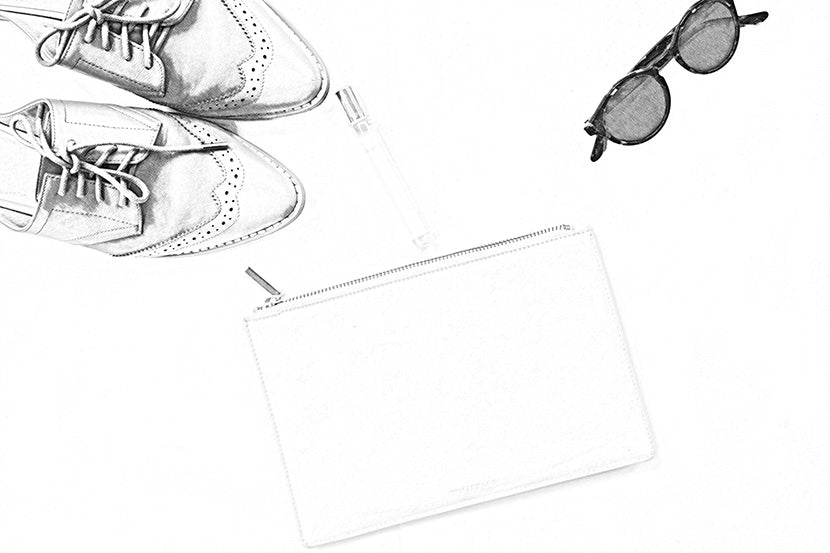
Now that you know how to turn a picture into a line drawing in Photoshop, be sure to check out our other Photoshop tutorials to master your skills.
Scan Photoshop tutorials and fine tune your image-editing skills


Source: https://pathedits.com/blogs/tips/how-turn-photo-into-pencil-sketch-with-photoshop
Posted by: woodsgreaughts.blogspot.com
0 Response to "How To Draw Realistically From A Picture"
Post a Comment